dm_00000001
Goal
Define glucose.
Condition
When identifying monosaccharides, remember glucose is a common one.
Text
Glucose is a monosaccharide.
A framework that uses a strong teacher LLM to extract problem-solving knowledge and compile it into an explicit cognitive agent with inspectable, editable knowledge states.
Extracted from experiment logs. Among 27 valid four-option problems with successful solutions, 5 representative cases matching the target behavior profile were selected for detailed trace analysis.
Method Overview
CAC operationalizes a failure-driven learning cycle, iterating through four specific steps to compile problem-solving knowledge into explicit, inspectable representations.
Explicit, human-readable declarative memory (DM) items that the agent retrieves during problem-solving.
Three action types: <G> Set Goal, <R> Update Working Memory, <A> Answer — mimicking cognitive architecture patterns.
Teacher LLM validates solution traces and provides corrective knowledge when failures are detected.
Five representative successful traces are shown below. Each step is taken directly from experiment logs, including action choice, retrieval, and state transitions.
Passes after 2 earlier failed attempts. 4 steps in the final trace. 10 KB items committed on pass.
Which of the following is characterized as dietary fiber?
<G>
Goal Transform
Identify which option is indigestible plant-based carbohydrate.
If the goal is 'Solve the problem' and the working memory states 'Cellulose is the primary plant-based carbohydrate that is indigestible and serves as dietary fiber', switch to action <A>.
Before
After
Before
After
Parsed Payload
{
  "action": "<G>",
  "next_goal": "Next Goal of Agent: Identify which option is indigestible plant-based carbohydrate."
}
Action Probability Vector
This case reaches a passing trace after 2 earlier attempts. Inspect how confidence and KB updates change across retries.
threshold = 50%
31
KB before
41
KB after
0
Teacher DM Added
10
Committed on pass
termination: answered_top_goal
step_count: 4
retry_step_count: 0
Immediately before the selected pass, the previous attempt failed and added 10 DM candidates.
retrieval score: 1.052
If the goal is 'Solve the problem' and the working memory states 'Cellulose is the primary plant-based carbohydrate that is indigestible and serves as dietary fiber', switch to action <A>.
retrieval score: 1.046
If the goal is 'Solve the problem' and the working memory states 'Cellulose is the primary plant-based carbohydrate that is indigestible', switch to action <A>.
retrieval score: 1.041
If the goal is 'Solve the problem' and the working memory contains 'Cellulose is indigestible', switch to action <A>.
retrieval score: 1.040
If the goal is 'Solve the problem' and the working memory contains 'Cellulose is a structural polysaccharide', switch to action <A>.
retrieval score: 1.039
If the goal is 'Solve the problem' and the working memory repeats 'Cellulose is the primary plant-based carbohydrate', switch to action <A>.
Only high-impact mechanics used in the actual runtime are listed below.

Agent state is explicit (`goal`, `working_memory`, `retrieved DM`) and action is chosen at each step.
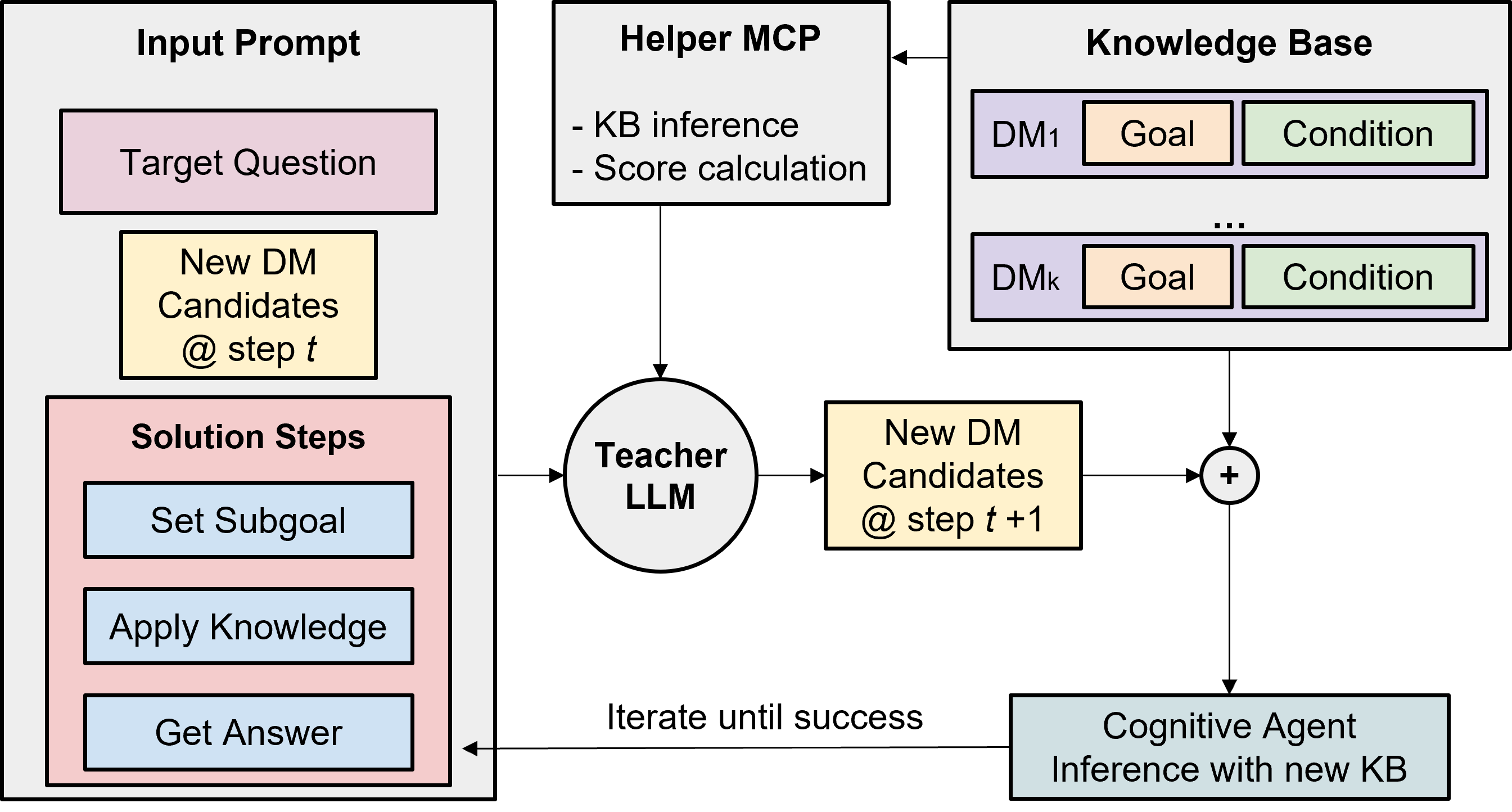
Teacher-generated DM candidates are staged first, then committed to global KB only when pass criteria are met.
Steps are accepted only after action-specific parse checks. In these 5 cases, retry generation fired 152 times across 52 steps, and 18 no-op updates were explicitly logged.
When same-action retries fail, the runtime attempts opposite-action recovery instead of aborting. This fallback executed 38 times in the current demo set.
The chosen action is not raw softmax only. Code-level action_bias terms are added to <G>/<R>/<A> logits to favor decomposition early and answering when the stack state indicates closure.
Each attempt runs on an overlay (global KB + staged candidates). Global KB commit happens on pass path only; failed-attempt commits in this demo are 0/10.
Final option is selected from scored tokens (" A/B/C/D"), then adjusted by text_bias. Bias was applied in 5/5 cases. Selected case output: pred=B, gold=B.
Browse declarative memory items in a dedicated scroll window.
Goal
Define glucose.
Condition
When identifying monosaccharides, remember glucose is a common one.
Text
Glucose is a monosaccharide.
Goal
Understand the components of carbohydrates.
Condition
When discussing carbohydrates, remember they are built from monosaccharides.
Text
Monosaccharides are the building blocks of carbohydrates.
Goal
Define galactose.
Condition
When identifying different monosaccharides, remember galactose is one of them.
Text
Galactose is a monosaccharide.
Goal
Define disaccharides.
Condition
When encountering a disaccharide, remember it's composed of two monosaccharides.
Text
Disaccharides are made of two monosaccharides.
Goal
Identify the carbohydrate with a different monosaccharide.
Condition
When needing to identify a carbohydrate with a different monosaccharide component, recall that lactose contains galactose in addition to glucose.
Text
Lactose is made of glucose and galactose.
Goal
Identify carbohydrates composed only of glucose.
Condition
When identifying carbohydrates made solely of glucose, remember glycogen, starch, and cellulose fit this description.
Text
Glycogen, starch, and cellulose are polymers of glucose.
Goal
Identify a carbohydrate with a different monosaccharide.
Condition
If the goal is to identify a carbohydrate with a different monosaccharide and you have identified it, switch to answering the question.
Text
After identifying a carbohydrate with a different monosaccharide, answer the question.
Goal
Identify a carbohydrate with a different monosaccharide.
Condition
If the current goal is to find a carbohydrate with a different monosaccharide, shift focus to disaccharides as they are composed of two different monosaccharides.
Text
If the goal is to identify a carbohydrate with a different monosaccharide, focus on disaccharides.
Goal
Solve the problem
Condition
If the goal is to solve the problem and the working memory states cheddar cheese is low in fiber, answer the question.
Text
If the goal is 'Solve the problem', and the working memory states that cheddar cheese is low in fiber, switch to action <A>.
Goal
Solve the problem
Condition
If the goal is to solve the problem and a food low in fiber has been identified, switch to answering the question.
Text
If the goal is 'Solve the problem', switch to action <A> after identifying a food low in fiber.
Goal
Identify foods low in fiber.
Condition
When asked about foods low in fiber, remember that cheddar cheese is a good example.
Text
Cheddar cheese is low in fiber.
Goal
Identify foods that help relieve constipation.
Condition
When asked about relieving constipation, remember that fiber-rich foods are helpful.
Text
Constipation is often relieved by foods high in fiber.
Goal
Identify foods high in fiber.
Condition
When asked about foods high in fiber, remember that pears with skin are a good example.
Text
Pears with skin are high in fiber.
Goal
Identify the food that does not contain high fiber.
Condition
If the question asks for the exception, focus on identifying foods low in fiber.
Text
Identify the food that does not contain high fiber.
Goal
Identify foods high in fiber.
Condition
When asked about foods high in fiber, remember that bran flakes are a good example.
Text
Bran flakes are high in fiber.
Goal
Identify the disaccharide containing fructose among the given food options.
Condition
If the goal is to identify a disaccharide and you have identified foods that help with constipation, switch to answering the question.
Text
If the goal is 'Identify the food that does not contain high fiber among the given options.', switch to action <A> after identifying the foods that help with constipation.
Goal
Identify foods high in fiber.
Condition
When asked about foods high in fiber, remember that black beans are a good example.
Text
Black beans are high in fiber.
Goal
Identify foods high in fiber, then identify the exception.
Condition
If the goal is to find an exception among helpful foods, first identify the helpful foods.
Text
After identifying foods high in fiber, identify the food that is low in fiber.
Goal
Identify the question's intent.
Condition
When the question uses 'EXCEPT', focus on identifying the outlier.
Text
The question asks for the food that would NOT help with constipation.
Goal
Identify the exception to a list of helpful foods.
Condition
If the goal is to identify the exception and you have identified helpful foods, switch to answering the question.
Text
If the goal is to identify the exception, switch to action <A> after identifying foods high in fiber.
Goal
Identify the disaccharide containing fructose among the given food options.
Condition
If the goal is to identify a disaccharide and the working memory mentions lactose, switch to answering the question.
Text
If the goal is 'Identify the disaccharide containing fructose among the given food options.', and the working memory mentions lactose, switch to action <A>.
Goal
Solve the problem
Condition
If the goal is to solve the problem and the working memory states that chitin and cellulose are both polysaccharides, add that they are both structural.
Text
If the goal is 'Solve the problem' and the working memory states that chitin and cellulose are both polysaccharides, switch to action <R> to add that they are both structural.
Goal
Solve the problem
Condition
If the goal is to solve the problem and the working memory contains 'Cellulose is most similar to chitin', answer the question.
Text
If the goal is 'Solve the problem' and the working memory contains 'Cellulose is most similar to chitin', switch to action <A>.
Goal
Solve the problem
Condition
If the goal is to solve the problem and the working memory states that chitin and cellulose are both polymers of glucose, add that they are both structural.
Text
If the goal is 'Solve the problem' and the working memory states that chitin and cellulose are both polymers of glucose, switch to action <R> to add that they are both structural.
Goal
Solve the problem
Condition
If the goal is to solve the problem and the working memory states that chitin and cellulose both provide structural support, answer the question.
Text
If the goal is 'Solve the problem' and the working memory states that chitin and cellulose both provide structural support, switch to action <A>.
Goal
Solve the problem
Condition
If the goal is to solve the problem and the working memory states that chitin and cellulose are both structural polysaccharides composed of glucose, answer the question.
Text
If the goal is 'Solve the problem' and the working memory states that chitin and cellulose are both structural polysaccharides composed of glucose, switch to action <A>.
Goal
Solve the problem
Condition
If the goal is to solve the problem and the working memory states that chitin and cellulose are both made of beta-1,4-glycosidic linkages, answer the question.
Text
If the goal is 'Solve the problem' and the working memory states that chitin and cellulose are both made of beta-1,4-glycosidic linkages, switch to action <A>.
Goal
Solve the problem
Condition
If the goal is to solve the problem and the working memory states that chitin and cellulose are both linear polysaccharides, answer the question.
Text
If the goal is 'Solve the problem' and the working memory states that chitin and cellulose are both linear polysaccharides, switch to action <A>.
Goal
Solve the problem
Condition
If the goal is to solve the problem and the working memory states that chitin is found in fungal cell walls and cellulose in plant cell walls, answer the question.
Text
If the goal is 'Solve the problem' and the working memory states that chitin is found in fungal cell walls and cellulose in plant cell walls, switch to action <A>.
Goal
Identify the specific structural polysaccharide most similar to chitin among the options
Condition
If the goal is to identify the polysaccharide and the working memory states that cellulose is a structural polysaccharide, answer the question.
Text
If the goal is 'Identify the specific structural polysaccharide most similar to chitin among the options' and the working memory states that cellulose is a structural polysaccharide, switch to action <A>.
Goal
Identify the specific structural polysaccharide most similar to chitin among the options
Condition
If the goal is to identify the polysaccharide and the working memory states that chitin and cellulose are both structural, answer the question.
Text
If the goal is 'Identify the specific structural polysaccharide most similar to chitin among the options' and the working memory states that chitin and cellulose are both structural, switch to action <A>.
Goal
Solve the problem
Condition
If the goal is to solve the problem and the working memory states 'Cellulose is the primary plant-based carbohydrate that is indigestible and serves as dietary fiber', answer the question.
Text
If the goal is 'Solve the problem' and the working memory states 'Cellulose is the primary plant-based carbohydrate that is indigestible and serves as dietary fiber', switch to action <A>.
Goal
Solve the problem
Condition
If the goal is to solve the problem and the working memory states 'Cellulose is the primary plant-based carbohydrate that is indigestible', answer the question.
Text
If the goal is 'Solve the problem' and the working memory states 'Cellulose is the primary plant-based carbohydrate that is indigestible', switch to action <A>.
Goal
Solve the problem
Condition
If the goal is to solve the problem and the working memory contains 'Cellulose is indigestible', answer the question.
Text
If the goal is 'Solve the problem' and the working memory contains 'Cellulose is indigestible', switch to action <A>.
Goal
Solve the problem
Condition
If the goal is to solve the problem and the working memory contains 'Cellulose is a structural polysaccharide', answer the question.
Text
If the goal is 'Solve the problem' and the working memory contains 'Cellulose is a structural polysaccharide', switch to action <A>.
Goal
Solve the problem
Condition
If the goal is to solve the problem and the working memory repeats 'Cellulose is the primary plant-based carbohydrate', answer the question.
Text
If the goal is 'Solve the problem' and the working memory repeats 'Cellulose is the primary plant-based carbohydrate', switch to action <A>.
Goal
Solve the problem
Condition
If the goal is to solve the problem and the working memory hasn't changed for two steps, answer the question.
Text
If the goal is 'Solve the problem' and the working memory is unchanged for two steps, switch to action <A>.
Goal
Identify the food source of dietary fiber from the options
Condition
If the goal is to identify the food source and the working memory states 'Cellulose is indigestible', answer the question.
Text
If the goal is 'Identify the food source of dietary fiber from the options' and the working memory states 'Cellulose is indigestible', switch to action <A>.
Goal
Identify the food source of dietary fiber from the options
Condition
If the goal is to identify the food source and the working memory repeats 'Cellulose is the primary plant-based carbohydrate', answer the question.
Text
If the goal is 'Identify the food source of dietary fiber from the options' and the working memory repeats 'Cellulose is the primary plant-based carbohydrate', switch to action <A>.
Goal
Define dietary fiber and give an example.
Condition
When asked about dietary fiber, state it's indigestible and give cellulose as an example.
Text
Dietary fiber is a carbohydrate that the body cannot digest, and cellulose is a primary example.
Goal
Describe cellulose as dietary fiber.
Condition
When discussing dietary fiber, state that cellulose is a plant-based, indigestible component.
Text
Cellulose is a type of dietary fiber found in plants and is not digestible by humans.
Goal
Solve the problem
Condition
If the working memory is 'Carbohydrates are hydrophilic and have the general formula CH2O', answer the question.
Text
If the goal is 'Solve the problem' and the working memory is 'Carbohydrates are hydrophilic and have the general formula CH2O', switch to action <A>.
Goal
Solve the problem
Condition
If the working memory is 'Carbohydrates are hydrophilic and have the general formula CHO', answer the question.
Text
If the goal is 'Solve the problem' and the working memory is 'Carbohydrates are hydrophilic and have the general formula CHO', switch to action <A>.
Goal
Solve the problem
Condition
If the working memory is 'Carbohydrates are hydrophobic and have the general formula CH2O', answer the question.
Text
If the goal is 'Solve the problem' and the working memory is 'Carbohydrates are hydrophobic and have the general formula CH2O', switch to action <A>.
Goal
Solve the problem
Condition
If the working memory is 'Carbohydrates are hydrophobic and have the general formula CHO', answer the question.
Text
If the goal is 'Solve the problem' and the working memory is 'Carbohydrates are hydrophobic and have the general formula CHO', switch to action <A>.
Goal
Solve the problem
Condition
If the working memory contains 'hydrophilic' and 'CH2O', answer the question.
Text
If the goal is 'Solve the problem' and the working memory contains 'hydrophilic' and 'CH2O', switch to action <A>.
Goal
Solve the problem
Condition
If the working memory states 'Option D is the correct answer', then the answer is D.
Text
If the goal is 'Solve the problem' and the working memory states 'Option D is the correct answer', then the answer is D.
Goal
Solve the problem
Condition
If the working memory states 'Option A is the correct answer', then the answer is A.
Text
If the goal is 'Solve the problem' and the working memory states 'Option A is the correct answer', then the answer is A.
Goal
Solve the problem
Condition
If the working memory repeats the same reasoning, answer the question.
Text
If the goal is 'Solve the problem' and the working memory repeats the same reasoning, switch to action <A>.
Goal
Define carbohydrates
Condition
When asked about carbohydrate characteristics.
Text
Carbohydrates are organic molecules containing carbon, hydrogen, and oxygen.
Goal
State carbohydrate formula
Condition
When asked about the chemical formula of carbohydrates.
Text
The general formula for carbohydrates is CH2O.
Goal
Define hydrophobic
Condition
When discussing solubility of molecules.
Text
Hydrophobic molecules repel water.
Goal
Define hydrophilic
Condition
When discussing solubility of molecules.
Text
Hydrophilic molecules are attracted to water.
Goal
Identify the correct property of carbohydrates among the options
Condition
If the working memory repeats the same reasoning, answer the question.
Text
If the goal is 'Identify the correct property of carbohydrates among the options' and the working memory is stuck repeating reasoning, switch to action <A>.
Goal
Solve the problem
Condition
If the goal is to solve the problem and the working memory states 'Glycogen is the primary form of energy storage in animals'.
Text
If the goal is 'Solve the problem' and the working memory states 'Glycogen is the primary form of energy storage in animals', switch to action <A>.
Goal
Solve the problem
Condition
If the goal is to solve the problem and the working memory states 'Glycogen as the animal energy storage carbohydrate'.
Text
If the goal is 'Solve the problem' and the working memory states 'Glycogen as the animal energy storage carbohydrate', switch to action <A>.
Goal
Solve the problem
Condition
If the goal is to solve the problem and the working memory states 'Glycogen is the animal energy storage carbohydrate'.
Text
If the goal is 'Solve the problem' and the working memory states 'Glycogen is the animal energy storage carbohydrate', switch to action <A>.
Goal
Solve the problem
Condition
If the goal is to solve the problem and the working memory contains 'glycogen is the primary form of energy storage'.
Text
If the goal is 'Solve the problem' and the working memory contains 'glycogen is the primary form of energy storage', switch to action <A>.
Goal
Solve the problem
Condition
If the goal is to solve the problem and the working memory contains 'glycogen'.
Text
If the goal is 'Solve the problem' and the working memory contains 'glycogen', switch to action <A>.
Goal
Identify the carbohydrate for animal energy storage.
Condition
After identifying glycogen as the animal energy storage carbohydrate.
Text
After identifying glycogen as the animal energy storage carbohydrate, answer the question.
Goal
Identify the carbohydrate for animal energy storage.
Condition
If the goal is to identify the carbohydrate for animal energy storage and the working memory mentions glycogen.
Text
If the goal is to identify the carbohydrate for animal energy storage and the working memory mentions glycogen, switch to action <A>.
Goal
Identify the carbohydrate for animal energy storage.
Condition
When asked about animal energy storage carbohydrates.
Text
Animals store glucose as glycogen for energy.
Goal
Compare starch and glycogen function.
Condition
When comparing plant and animal energy storage carbohydrates.
Text
Starch is for plants; glycogen is for animals.
Goal
Describe glycogen composition.
Condition
When the goal is to describe glycogen.
Text
Glycogen is made of glucose units.
Goal
Solve the problem
Condition
If the working memory contains the relative sizes of ribose, lactose, sucrose, and starch, answer the question.
Text
If the goal is to 'Solve the problem' and the working memory states that ribose is a monosaccharide, lactose and sucrose are disaccharides, and starch is a polysaccharide, switch to action <A>.
Goal
Solve the problem
Condition
If the working memory states that ribose is the smallest molecule, answer the question.
Text
If the goal is 'Solve the problem' and the working memory states that 'Ribose is the smallest molecule', switch to action <A>.
Goal
Solve the problem
Condition
If the working memory states that ribose is the smallest molecule and explains why, answer the question.
Text
If the goal is 'Solve the problem' and the working memory states that 'Ribose is the smallest molecule because it is a monosaccharide', switch to action <A>.
Goal
Solve the problem
Condition
If the working memory lacks information about the relative sizes of the carbohydrates, compare their molecular weights.
Text
If the goal is 'Solve the problem' and the working memory does not contain information about the relative sizes of the carbohydrates, switch to action <G> to compare their molecular weights.
Goal
Solve the problem
Condition
If the working memory is empty when trying to solve the problem, restate the problem.
Text
If the goal is 'Solve the problem' and the working memory is empty, switch to action <R> to restate the problem.
Goal
Identify disaccharides.
Condition
When comparing carbohydrates, recognize that lactose and sucrose are composed of two sugar molecules.
Text
Lactose and sucrose are disaccharides.
Goal
Identify monosaccharides.
Condition
When comparing carbohydrates, recognize that ribose is a single sugar molecule.
Text
Ribose is a monosaccharide.
Goal
Identify polysaccharides.
Condition
When comparing carbohydrates, remember that starch is a complex carbohydrate made of many sugar molecules.
Text
Starch is a polysaccharide.
Goal
Identify the smallest carbohydrate.
Condition
When comparing carbohydrates, remember that monosaccharides are the simplest form.
Text
Monosaccharides are the smallest carbohydrates.
Goal
Compare molecular weights of Lactose, Sucrose, Starch, and Ribose to find the smallest.
Condition
If the working memory states the relative sizes of the carbohydrates, answer the question.
Text
If the goal is 'Compare molecular weights of Lactose, Sucrose, Starch, and Ribose to find the smallest' and the working memory states that 'Ribose is the smallest molecule because it is a monosaccharide, whereas the others are disaccharides or polysaccharides', switch to action <A>.
Goal
Solve the problem
Condition
The working memory contains 'ionic bonds'.
Text
If the goal is 'Solve the problem' and the working memory contains 'ionic bonds', switch to action <A> to evaluate the statement.
Goal
Solve the problem
Condition
The working memory contains 'covalent bonds'.
Text
If the goal is 'Solve the problem' and the working memory contains 'covalent bonds', switch to action <A> to evaluate the statement.
Goal
Solve the problem
Condition
The working memory contains 'carbon'.
Text
If the goal is 'Solve the problem' and the working memory contains 'carbon', switch to action <A> to evaluate the statement.
Goal
Solve the problem
Condition
The working memory contains 'nitrogen'.
Text
If the goal is 'Solve the problem' and the working memory contains 'nitrogen', switch to action <A> to evaluate the statement.
Goal
Solve the problem
Condition
The working memory contains 'polymers'.
Text
If the goal is 'Solve the problem' and the working memory contains 'polymers', switch to action <A> to evaluate the statement.
Goal
Solve the problem
Condition
The agent is stuck repeating the goal 'Solve the problem'.
Text
If the agent repeats the goal 'Solve the problem' without making progress, switch to action <A> to provide an answer.
Goal
Solve the problem
Condition
The working memory contains 'Option C is incorrect'.
Text
If the goal is 'Solve the problem' and the working memory contains 'Option C is incorrect', switch to action <A> to answer the question.
Goal
Solve the problem
Condition
The working memory contains 'Option D is incorrect'.
Text
If the goal is 'Solve the problem' and the working memory contains 'Option D is incorrect', switch to action <A> to answer the question.
Goal
Solve the problem
Condition
The working memory contains 'Option A is incorrect'.
Text
If the goal is 'Solve the problem' and the working memory contains 'Option A is incorrect', switch to action <A> to answer the question.
Goal
Describe bonding in organic molecules.
Condition
When discussing the types of chemical bonds in organic molecules.
Text
Covalent bonds hold atoms together in organic molecules.
Goal
Evaluate a statement.
Condition
The working memory contains a statement about a chemical bond type.
Text
After evaluating a statement about a chemical bond type, switch to action <A> to answer the question.
Goal
Define organic molecules.
Condition
When identifying the key element in organic molecules.
Text
Organic molecules always contain carbon.
Goal
Define monomers and polymers.
Condition
When discussing the relationship between monomers and polymers.
Text
Monomers are the building blocks of polymers.
Goal
State the basis of life.
Condition
When discussing the chemical foundation of living organisms.
Text
Life as we know it is carbon-based.
Goal
Carbon's tetravalency enables diverse molecular structures.
Condition
When the working memory contains only 'Carbon's four covalent bonds create varied molecular structures'.
Text
If the goal is 'Carbon's tetravalency enables diverse molecular structures.' and the working memory contains only 'Carbon's four covalent bonds create varied molecular structures.', switch to action <A>.
Goal
Carbon's tetravalency enables diverse molecular structures.
Condition
When the working memory repeats 'Carbon's four covalent bonds create varied molecular structures.' for 2 steps.
Text
If the goal is 'Carbon's tetravalency enables diverse molecular structures.' and the working memory repeats 'Carbon's four covalent bonds create varied molecular structures.' for 2 steps, switch to action <A>.
Goal
Carbon's tetravalency enables diverse molecular structures.
Condition
When the action is <R> and the goal is 'Carbon's tetravalency enables diverse molecular structures'.
Text
If the goal is 'Carbon's tetravalency enables diverse molecular structures.' and the action is <R>, the working memory should explain how carbon's bonding leads to shape diversity.
Goal
Carbon's tetravalency enables diverse molecular structures.
Condition
When the working memory contains 'Carbon's four covalent bonds'.
Text
If the goal is 'Carbon's tetravalency enables diverse molecular structures.' and the working memory contains 'Carbon's four covalent bonds', add that this allows for a variety of structures.
Goal
Carbon's tetravalency enables diverse molecular structures.
Condition
When the working memory does not mention the number of covalent bonds carbon can form.
Text
If the goal is 'Carbon's tetravalency enables diverse molecular structures.' and the working memory does not mention the number of covalent bonds carbon can form, add that carbon can form four covalent bonds.
Goal
Carbon's tetravalency enables diverse molecular structures.
Condition
When the working memory remains the same for 2 consecutive steps.
Text
If the goal is 'Carbon's tetravalency enables diverse molecular structures.' and the working memory is unchanged for 2 steps, switch to action <A>.
Goal
Carbon's tetravalency enables diverse molecular structures.
Condition
When the working memory remains the same for 1 consecutive step.
Text
If the goal is 'Carbon's tetravalency enables diverse molecular structures.' and the working memory is unchanged for 1 step, switch to action <A>.
Goal
Carbon's tetravalency enables diverse molecular structures.
Condition
When the working memory remains the same for 3 consecutive steps.
Text
If the goal is 'Carbon's tetravalency enables diverse molecular structures.' and the working memory is unchanged for 3 steps, switch to action <A>.
Goal
Explain carbon's bonding capacity.
Condition
When discussing carbon's ability to form covalent bonds.
Text
Carbon can form up to four covalent bonds, allowing for a variety of molecular structures.
Goal
Solve the problem
Condition
When the working memory contains 'Carbon's tetravalency enables diverse molecular structures'.
Text
If the goal is 'Solve the problem' and the working memory contains 'Carbon's tetravalency enables diverse molecular structures', switch to action <A>.
Goal
Solve the problem
Condition
When the working memory contains 'Carbon can form four covalent bonds'.
Text
If the goal is 'Solve the problem' and the working memory contains 'Carbon can form four covalent bonds', switch to action <A>.
Goal
Solve the problem
Condition
When the working memory contains 'Carbon forms four covalent bonds'.
Text
If the goal is 'Solve the problem' and the working memory contains 'Carbon forms four covalent bonds', switch to action <A>.
Goal
Solve the problem
Condition
When the working memory contains 'Carbon's tetravalency'.
Text
If the goal is 'Solve the problem' and the working memory contains 'Carbon's tetravalency', switch to action <A>.
Goal
Solve the problem
Condition
The working memory contains 'Teflic acid is inorganic'.
Text
If the goal is 'Solve the problem' and the working memory contains 'Teflic acid is inorganic', switch to action <A>.
Goal
Solve the problem
Condition
The working memory contains 'Teflic acid lacks carbon'.
Text
If the goal is 'Solve the problem' and the working memory contains 'Teflic acid lacks carbon', switch to action <A>.
Goal
Solve the problem
Condition
The working memory contains 'Teflic acid is not organic'.
Text
If the goal is 'Solve the problem' and the working memory contains 'Teflic acid is not organic', switch to action <A>.
Goal
Solve the problem
Condition
The working memory states that a molecule lacks carbon.
Text
If the goal is 'Solve the problem' and the working memory states that a molecule lacks carbon, switch to action <A>.
Goal
Solve the problem
Condition
The working memory contains 'Teflic acid is not organic because it lacks carbon atoms'.
Text
If the goal is 'Solve the problem' and the working memory contains 'Teflic acid is not organic because it lacks carbon atoms', switch to action <A>.
Goal
Solve the problem
Condition
The working memory contains 'Teflic acid is not organic because it has no carbon atoms'.
Text
If the goal is 'Solve the problem' and the working memory contains 'Teflic acid is not organic because it has no carbon atoms', switch to action <A>.
Goal
Determine the next step to solve the problem.
Condition
When the problem asks about teflic acid's organic nature, focus on carbon.
Text
To answer the question, determine if teflic acid contains carbon.
Goal
Recall the composition of teflic acid.
Condition
When the problem discusses teflic acid, remember its elements.
Text
Teflic acid does not contain carbon atoms.
Goal
Determine if a molecule is organic based on carbon content.
Condition
When evaluating if a molecule is organic, check for carbon.
Text
If a molecule does not contain carbon, it is not an organic molecule.
Goal
Recall the definition of organic molecules.
Condition
When determining if a molecule is organic, focus on carbon.
Text
Organic molecules always contain carbon atoms.
Goal
Identify the specific chemical class of teflic acid based on its lack of carbon atoms
Condition
The working memory states 'Teflic acid is classified as an inorganic molecule due to the absence of carbon'.
Text
If the goal is 'Identify the specific chemical class of teflic acid based on its lack of carbon atoms' and the working memory states 'Teflic acid is classified as an inorganic molecule due to the absence of carbon', switch to action <A>.
Goal
Solve the problem
Condition
Working memory states fatty acids are subunits.
Text
If the goal is 'Solve the problem' and the working memory contains 'Fatty acids are subunits', switch to action <A>.
Goal
Solve the problem
Condition
Working memory states fatty acids bond to glycerol.
Text
If the goal is 'Solve the problem' and the working memory contains 'Fatty acids bond to glycerol', switch to action <A>.
Goal
Solve the problem
Condition
Working memory states fatty acids are monomers.
Text
If the goal is 'Solve the problem' and the working memory contains 'Fatty acids are monomers', switch to action <A>.
Goal
Solve the problem
Condition
Working memory states fatty acids are building blocks of lipids.
Text
If the goal is 'Solve the problem' and the working memory contains 'Fatty acids are building blocks of lipids', switch to action <A>.
Goal
Solve the problem
Condition
Working memory states lipids are made of fatty acids.
Text
If the goal is 'Solve the problem' and the working memory contains 'Lipids are made of fatty acids', switch to action <A>.
Goal
Solve the problem
Condition
Working memory states that fatty acids are the subunits of lipids.
Text
If the goal is 'Solve the problem' and the working memory contains 'Fatty acids are the subunits of lipids', switch to action <A>.
Goal
Solve the problem
Condition
Working memory states fatty acids are the building blocks of lipids.
Text
If the goal is 'Solve the problem' and the working memory contains 'Fatty acids are the building blocks of lipids', switch to action <A>.
Goal
Solve the problem
Condition
Working memory states lipids are formed from fatty acids.
Text
If the goal is 'Solve the problem' and the working memory contains 'Lipids are formed from fatty acids', switch to action <A>.
Goal
Solve the problem
Condition
Working memory states that fatty acids are monomers that form lipids.
Text
If the goal is 'Solve the problem' and the working memory contains 'Fatty acids are monomers that form lipids', switch to action <A>.
Goal
Solve the problem
Condition
Working memory states the complete relationship between fatty acids, glycerol, and lipids.
Text
If the goal is 'Solve the problem' and the working memory contains 'Fatty acids bond to glycerol to form lipid macromolecules', switch to action <A>.
Goal
Identify the monomer that bonds with water to form carbohydrates.
Condition
The goal is repeatedly 'Identify the monomer that bonds with water to form carbohydrates.' and the agent is stuck.
Text
Identify the monomer that bonds with water to form carbohydrates.
Goal
Identify monomers forming carbohydrates.
Condition
If the question asks about monomers of carbohydrates, recall that sugars are the monomers.
Text
Sugars are monomers that form carbohydrates.
Goal
Identify carbohydrate monomers.
Condition
When asked about carbohydrate building blocks, remember they are made of sugar monomers.
Text
Carbohydrates are made of sugar monomers.
Goal
Identify carbohydrate monomers.
Condition
If the agent is repeatedly recalling disaccharides, shift the focus to identifying the monomers that make them up.
Text
If repeatedly recalling disaccharides, switch to identifying monomers.
Goal
Identify carbohydrate monomers.
Condition
If the goal is to identify carbohydrate monomers and progress is stalled, refocus on sugars.
Text
If stuck identifying carbohydrate monomers, focus on sugars.
Goal
Identify the components of lactose.
Condition
If asked about lactose, remember it's made of glucose and galactose.
Text
Lactose is a disaccharide of glucose and galactose.
Goal
Identify a monosaccharide.
Condition
If needing an example of a monosaccharide, remember fructose.
Text
Fructose is a monosaccharide.
Goal
Identify the components of sucrose.
Condition
If asked about sucrose, remember it's made of glucose and fructose.
Text
Sucrose is a disaccharide of glucose and fructose.
Goal
Define carbohydrates.
Condition
When asked about carbohydrates, remember they are polymers of sugar monomers.
Text
Carbohydrates are polymers of sugar monomers.
Goal
Define monosaccharides.
Condition
When discussing sugar monomers, remember monosaccharides are the simplest form.
Text
Monosaccharides are the simplest sugar monomers.
Goal
Define polysaccharides.
Condition
When discussing carbohydrates, remember polysaccharides are long chains of monosaccharides.
Text
Polysaccharides are long chains of monosaccharides.
Goal
Define polymers.
Condition
When discussing polymers, remember they are made of repeating monomer units.
Text
Polymers are made of repeating monomer units.
Goal
Solve the problem
Condition
The goal is to solve the problem and the working memory indicates the protein monomer has been identified.
Text
If the goal is to 'Solve the problem' and the working memory indicates the monomer for proteins has been identified, switch to answering the question.
Goal
Solve the problem
Condition
The goal is to solve the problem and the working memory contains 'Amino acids are the monomers used to build proteins'.
Text
If the goal is 'Solve the problem' and the working memory contains 'Amino acids are the monomers used to build proteins', switch to answering the question.
Goal
Solve the problem
Condition
The goal is to solve the problem and the agent is stuck.
Text
If the goal is 'Solve the problem' and the agent is stuck, consider identifying the monomers for other types of molecules.
Goal
Solve the problem
Condition
The goal is to solve the problem and the agent has repeatedly generated the same goal.
Text
If the goal is 'Solve the problem' and the agent has repeatedly generated the same goal, switch to answering the question.
Goal
Identify the monomer for proteins
Condition
When asked about protein monomers, remember the answer is amino acids.
Text
The monomer for proteins is amino acids.
Goal
Identify the correct monomer for proteins from the given options
Condition
The goal is to identify the protein monomer and the agent has identified the monomer.
Text
If the goal is 'Identify the correct monomer for proteins from the given options', and the agent has identified the monomer, switch to answering the question.
Goal
Identify the correct monomer for proteins from the given options
Condition
The goal is to identify the protein monomer and the agent has already identified the monomer.
Text
If the goal is 'Identify the correct monomer for proteins from the given options' and the agent has already identified the monomer, switch to answering the question.
Goal
Identify the correct monomer for proteins from the given options
Condition
The goal is to identify the protein monomer and the agent is stuck.
Text
If the goal is 'Identify the correct monomer for proteins from the given options' and the agent is stuck, recall that proteins are built from amino acids.
Goal
Identify the correct monomer for proteins from the given options
Condition
The goal is to identify the protein monomer and the working memory does not contain 'amino acids'.
Text
If the goal is 'Identify the correct monomer for proteins from the given options' and the working memory does not contain 'amino acids', recall that proteins are built from amino acids.
Goal
Identify the correct monomer for proteins from the given options
Condition
The goal is to identify the protein monomer and the agent is stuck in a loop.
Text
If the goal is 'Identify the correct monomer for proteins from the given options' and the agent is stuck in a loop, switch to answering the question.
Goal
Identify the correct monomer for proteins from the given options
Condition
The goal is to identify the protein monomer and the agent is repeatedly recalling information about other monomers.
Text
If the goal is 'Identify the correct monomer for proteins from the given options' and the agent is repeatedly recalling information about other monomers, switch to answering the question.
Goal
Identify protein monomers
Condition
When asked about proteins, remember they are built from amino acids.
Text
Proteins are polymers made of amino acid monomers.
Goal
Solve the problem
Condition
The working memory is 'The lipid is a steroid'.
Text
If the goal is 'Solve the problem' and the working memory is 'The lipid is a steroid', switch to action <A>.
Goal
Solve the problem
Condition
The working memory contains 'steroid'.
Text
If the goal is 'Solve the problem' and the working memory contains 'steroid', switch to action <A>.
Goal
Solve the problem
Condition
The working memory states 'The lipid has four fused rings'.
Text
If the goal is 'Solve the problem' and the working memory states 'The lipid has four fused rings', switch to action <A>.
Goal
Solve the problem
Condition
The working memory contains 'four fused rings'.
Text
If the goal is 'Solve the problem' and the working memory contains 'four fused rings', the answer is 'steroid'.
Goal
Identify steroids.
Condition
The problem describes a lipid with four fused rings.
Text
Steroids are lipids with four fused hydrocarbon rings.
Goal
Classify lipids based on ring structure.
Condition
The lipid molecule has four fused hydrocarbon rings.
Text
Lipids with four fused rings are classified as steroids.
Goal
Describe steroid composition.
Condition
The problem describes a lipid lacking fatty acids and phosphate groups.
Text
Steroids do not contain long fatty acid chains or phosphate groups.
Goal
Identify the specific class of lipid
Condition
The working memory states 'no fatty acid chains'.
Text
If the goal is 'Identify the specific class of lipid' and the working memory states 'no fatty acid chains', consider 'steroid'.
Goal
Identify the specific class of lipid
Condition
The working memory states 'no phosphate group'.
Text
If the goal is 'Identify the specific class of lipid' and the working memory states 'no phosphate group', consider 'steroid'.
Goal
Identify the specific class of lipid
Condition
The working memory states 'four fused rings'.
Text
If the goal is 'Identify the specific class of lipid' and the working memory states 'four fused rings', the answer is 'steroid'.
Goal
Solve the problem
Condition
Working memory states 'This molecule is a lipid'.
Text
If the goal is 'Solve the problem' and the working memory contains 'This molecule is a lipid', switch to action <A>.
Goal
Solve the problem
Condition
Agent is repeating the same goal.
Text
If the goal is 'Solve the problem' and the agent is repeating the same goal, switch to action <A>.
Goal
Solve the problem
Condition
Agent is repeatedly performing action <A>.
Text
If the goal is 'Solve the problem' and the agent is repeating action <A>, stop and select the best answer.
Goal
Identify the specific macromolecule type based on the polar head and hydrocarbon tails
Condition
Working memory states 'The molecule is a lipid'.
Text
If the goal is 'Identify the specific macromolecule type based on the polar head and hydrocarbon tails' and the working memory contains 'The molecule is a lipid', switch to action <A>.
Goal
Identify the specific macromolecule type based on the polar head and hydrocarbon tails
Condition
Working memory states 'This molecule is a lipid'.
Text
If the goal is 'Identify the specific macromolecule type based on the polar head and hydrocarbon tails' and the working memory contains 'This molecule is a lipid', then the answer is 'C'.
Goal
Identify the specific macromolecule type based on the polar head and hydrocarbon tails
Condition
Agent is repeating the same goal.
Text
If the goal is 'Identify the specific macromolecule type based on the polar head and hydrocarbon tails' and the agent is repeating the same goal, switch to action <A>.
Goal
Identify the specific macromolecule type based on the polar head and hydrocarbon tails
Condition
Agent is repeatedly performing action <A>.
Text
If the goal is 'Identify the specific macromolecule type based on the polar head and hydrocarbon tails' and the agent is repeating action <A>, stop and select the best answer.
Goal
Solve the problem
Condition
Working memory states phospholipids are the main component of cell membranes.
Text
If the goal is 'Solve the problem' and the working memory contains 'Phospholipids are the main component of cell membranes', switch to action <A>.
Goal
Solve the problem
Condition
Working memory states phospholipids are the primary component of the cell membrane and the agent has repeatedly used action <G>.
Text
If the goal is 'Solve the problem' and the working memory contains 'Phospholipids are the primary component of cell membranes', do not repeat <G>; switch to action <A>.
Goal
Solve the problem
Condition
Working memory states phospholipids are the primary component of the cell membrane and the agent has repeatedly used action <R>.
Text
If the goal is 'Solve the problem' and the working memory contains 'Phospholipids are the primary component of cell membranes', do not repeat <R>; switch to action <A>.
Goal
Solve the problem
Condition
Working memory states phospholipids form the bilayer structure of cell membranes.
Text
If the goal is 'Solve the problem' and the working memory contains 'Phospholipids form the bilayer structure of cell membranes', switch to action <A>.
Goal
Solve the problem
Condition
Working memory states phospholipids are the main component of cell membranes and the agent has repeatedly used action <G>.
Text
If the goal is 'Solve the problem' and the working memory contains 'Phospholipids are the main component of cell membranes', do not repeat <G>; switch to action <A>.
Goal
Solve the problem
Condition
Working memory states phospholipids are the main component of cell membranes and the agent has repeatedly used action <R>.
Text
If the goal is 'Solve the problem' and the working memory contains 'Phospholipids are the main component of cell membranes', do not repeat <R>; switch to action <A>.
Goal
Solve the problem
Condition
Working memory states phospholipids create the bilayer structure of cell membranes.
Text
If the goal is 'Solve the problem' and the working memory contains 'Phospholipids create the bilayer structure of cell membranes', switch to action <A>.
Goal
Solve the problem
Condition
The working memory has not changed after a reasoning step.
Text
If the goal is 'Solve the problem' and the working memory is unchanged, switch to action <A>.
Goal
Identify the main component of cell membranes
Condition
Agent needs to know the primary component of cell membranes.
Text
Cell membranes are primarily made of phospholipids.
Goal
Understand cell membrane structure
Condition
Agent needs to understand how cell membranes are structured.
Text
Phospholipids form a bilayer in cell membranes.
Goal
Identify the primary component of cell membranes
Condition
Working memory states phospholipids create the bilayer structure of cell membranes.
Text
If the goal is 'Identify the primary component of cell membranes' and the working memory contains 'Phospholipids create the bilayer structure of cell membranes', switch to action <A>.
Goal
Identify the primary component of cell membranes
Condition
Working memory states phospholipids are the main component.
Text
If the goal is 'Identify the primary component of cell membranes' and the working memory contains 'Phospholipids are the main component', switch to action <A>.
Goal
Identify the primary component of cell membranes
Condition
Working memory states phospholipids form the bilayer structure.
Text
If the goal is 'Identify the primary component of cell membranes' and the working memory contains 'Phospholipids form the bilayer structure', switch to action <A>.
Goal
Identify the primary component of cell membranes
Condition
The working memory has not changed after a reasoning step.
Text
If the goal is 'Identify the primary component of cell membranes' and the working memory is unchanged, switch to action <A>.
Goal
Solve the problem
Condition
Working memory contains a lipid type.
Text
If the goal is 'Solve the problem' and the working memory contains a lipid type, switch to action <A> to answer the question.
Goal
Solve the problem
Condition
Working memory contains 'Triglycerides are the main lipid for energy storage'.
Text
If the goal is 'Solve the problem' and the working memory contains 'Triglycerides are the main lipid for energy storage', switch to action <A>.
Goal
Answer the question
Condition
The energy storage lipid has been identified.
Text
After identifying the energy storage lipid, answer the question.
Goal
Wax function
Condition
The topic is wax function.
Text
Waxes are used for waterproofing, not energy storage.
Goal
Phospholipid function
Condition
The topic is phospholipid function.
Text
Phospholipids are the main structural component of cell membranes, not energy storage.
Goal
Steroid function
Condition
The topic is steroid function.
Text
Steroids are signaling molecules and hormones, not primary energy stores.
Goal
Triglyceride function
Condition
The topic is triglyceride function.
Text
Triglycerides are composed of glycerol and three fatty acids and are used for long-term energy storage.
Goal
Identify the specific lipid type among options that serves as the primary energy storage molecule.
Condition
Working memory mentions 'energy storage'.
Text
If the goal is 'Identify the specific lipid type among options that serves as the primary energy storage molecule.' and the working memory mentions 'energy storage', switch to action <R> to recall the specific lipid.
Goal
Identify the specific lipid type among options that serves as the primary energy storage molecule.
Condition
Working memory does NOT mention triglycerides.
Text
If the goal is 'Identify the specific lipid type among options that serves as the primary energy storage molecule.' and the working memory does NOT mention triglycerides, switch to action <G> to find the energy storage lipid.
Goal
Identify the specific lipid type among options that serves as the primary energy storage molecule.
Condition
Working memory contains a non-helpful lipid.
Text
If the goal is 'Identify the specific lipid type among options that serves as the primary energy storage molecule.' and the working memory contains a non-helpful lipid, switch to action <G> to find the energy storage lipid.
Goal
Identify the specific lipid type among options that serves as the primary energy storage molecule.
Condition
Working memory mentions a lipid that is NOT for energy storage.
Text
If the goal is 'Identify the specific lipid type among options that serves as the primary energy storage molecule.' and the working memory mentions a lipid that is NOT for energy storage, switch to action <G> to find the energy storage lipid.